
Quick answer: Bring your thumb and little finger together, then wrap a soft tape measure around the widest part of your hand (across the knuckles). Match that number to the chart below. Most women in the UK wear a 2.4 or 2.6 bangle. If you land between two sizes, go up one size.
Bangles don’t open like a bracelet with a clasp. They have to slide over your hand, so the size that matters is your hand, not your wrist. Too small and it won’t go on. Too big and it slips off. This guide shows you how to find your size at home in two minutes, with nothing more than a tape measure or a piece of string.
How to measure your bangle size at home
Method 1: Measure your hand (best if you don’t own a bangle)
- Bring your thumb and little finger together, as if you’re about to slide a bangle on.
- Wrap a soft tape measure, or a piece of string, around the widest part of your hand, over the knuckles.
- If you used string, mark where it meets, lay it flat and measure it against a ruler.
- Write the number down in centimetres and check it against the chart below.
Method 2: Measure a bangle that already fits you
- Put the bangle on a flat surface.
- Measure straight across the inside from one edge to the other. This is the inner diameter.
- Don’t include the metal itself. Only the empty space in the middle counts.
- Match the number to the “inner diameter” column below.
Bangle size chart (UK, in cm and inches)
| Bangle size | Inner diameter | Inner diameter (inches) | Hand measurement (approx.) |
|---|---|---|---|
| 2.2 | 5.4 cm | 2.12″ | about 17 cm |
| 2.4 | 5.7 cm | 2.25″ | about 18 cm |
| 2.6 | 6.0 cm | 2.37″ | about 19 cm |
| 2.8 | 6.4 cm | 2.50″ | about 20 cm |
| 2.10 | 6.7 cm | 2.62″ | about 21 cm |
| 2.12 | 7.0 cm | 2.75″ | about 22 cm |
Hand measurements are approximate. Everyone’s hands are shaped a little differently, so use the chart as a guide rather than an exact rule.
Tips for getting the right fit
- Between sizes? Go up. A bangle that’s slightly loose is comfortable. One that’s too tight won’t go over your knuckles at all.
- Measure at the end of the day. Hands can swell a little in warm weather or later in the day, so this gives a more honest number.
- Stacking? If you like wearing several bangles together, stick to the same size so they sit neatly as a set.
- Buying a gift? Borrow a bangle she already wears and measure the inside, or measure her hand the next time you’re together, subtly!
- Always check the listing. Each product page gives its own measurements, so compare those with your number before you order.
Bangle sizes for weddings, Eid and gifting
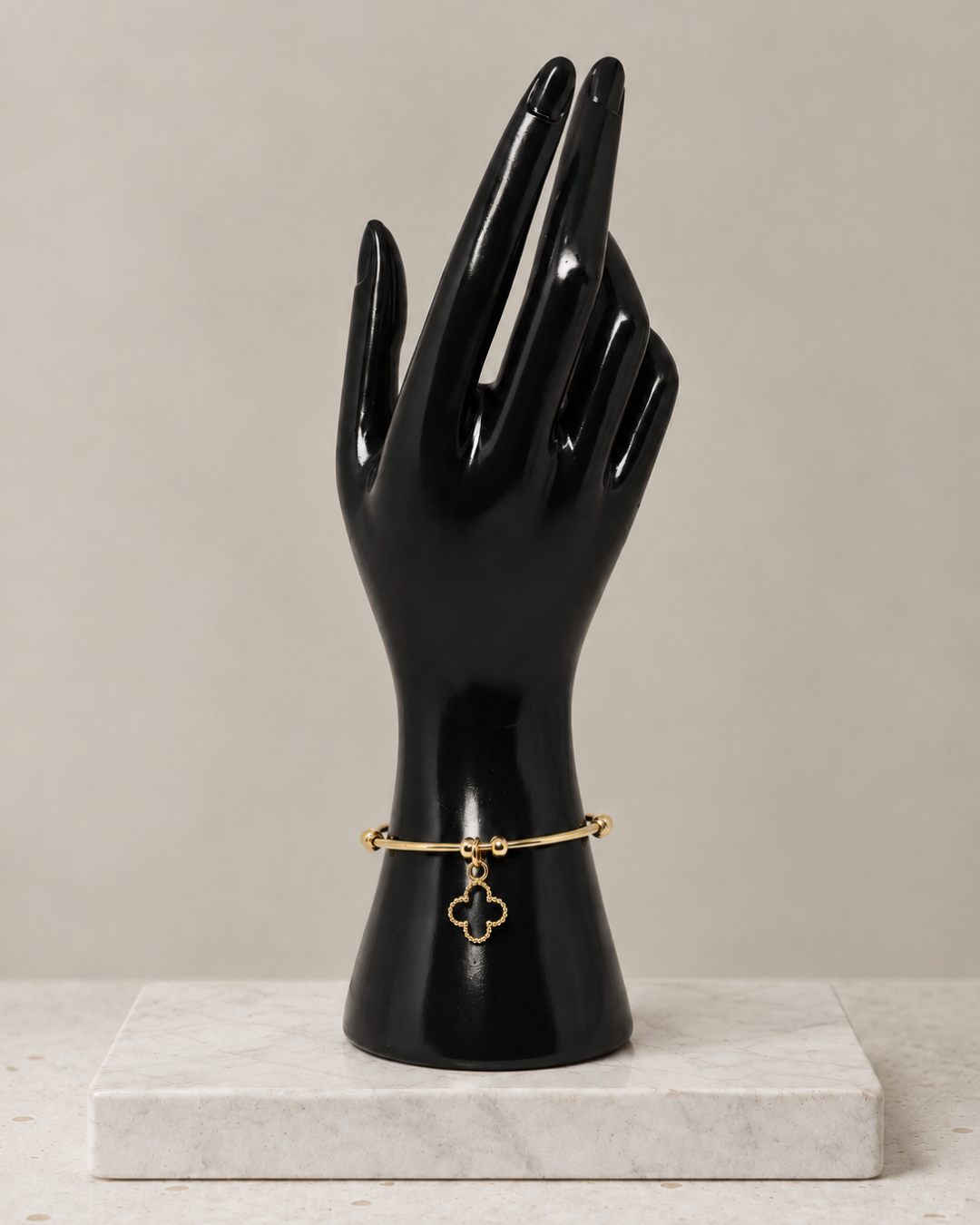
Bangles are one of the most-loved gifts for weddings, mehndi nights and Eid. If you’re buying a set for a bride or for a family occasion, it’s worth getting everyone’s size right first, because a stack that fits looks far more polished. Take a look at our bracelets and bangles, like the dainty gold-tone clover charm bangle, and see our Eid gift ideas for her for more inspiration.
Once you’ve found your perfect bangle, keep it shining with our guide on how to care for stainless steel jewellery.
Frequently asked questions
What is the most common bangle size for women in the UK?
Most women wear a 2.4 or a 2.6. That’s an inner diameter of about 5.7 cm to 6.0 cm. Petite hands often suit a 2.2, and larger hands a 2.8.
Is bangle size the same as bracelet size?
No. A bracelet with a clasp is sized by your wrist. A bangle has no clasp and must slide over your hand, so it’s sized by the widest part of your hand across the knuckles.
What does 2.4 mean in bangle sizes?
It’s a traditional sizing code. A 2.4 bangle has an inner diameter of 2.25 inches, which is about 5.7 cm.
What if my bangle is too big?
A slightly loose bangle is normal and comfortable. If it keeps sliding off your hand, go down one size. You can also stack it with other bangles to hold it in place.
Can I measure my bangle size without a tape measure?
Yes. Wrap a piece of string or a strip of paper around your hand over the knuckles, with your thumb and little finger touching. Mark it, lay it flat and measure it with a ruler.